

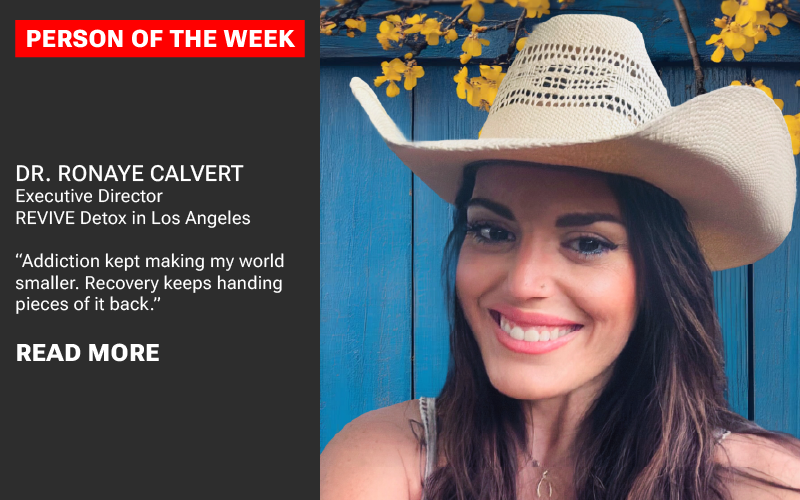
Dr. Ronaye Calvert is Executive Director of REVIVE Detox in Los Angeles. With nearly two decades devoted to addiction and trauma, she believes recovery is less about becoming someone new than returning to who we were meant to be—and that ethical, deeply human treatment can help people find their way home.
REVIVE Detox in Los Angeles
Dr. Ronaye Calvert has spent nearly two decades working in addiction and trauma, but her understanding of recovery is rooted in something larger than treatment alone. As Executive Director of REVIVE Detox in Los Angeles, she believes recovery is less about becoming someone new than returning to who we were meant to be—and that ethical, deeply human treatment can help people find their way home.
Her perspective is shaped by professional experience, personal recovery, spirituality, connection, and an enduring belief in what people can become.
On Courage, Fear, and Taking the Next Step
One of the most important lessons Calvert has learned is not to confuse discomfort with danger.
“Some of the best things that will ever happen to you begin on the other side of wanting to run,” she says. “Stay. Get curious. Give life a chance to surprise you.”
That philosophy extends into the way she thinks about courage. If she could speak to her younger self, she would remind her that fear does not need to disappear before life can begin.
“You don’t have to be less afraid before you begin. Courage isn’t the absence of fear. Sometimes it’s simply refusing to let fear make the decision.”
For Calvert, some of the greatest risks in life have involved stepping forward without knowing exactly who she would become on the other side. Recovery was one of those risks. Building something she believed in was another. So was choosing to love people without guarantees.
It has taught her that strength does not require becoming hardened.
“I can do hard things without becoming hard,” she says. “I can hurt, be disappointed, be uncertain, and still choose connection, integrity, spirituality, and the next right thing.”
What Recovery Really Gives Back
Ask Calvert what she loves most about living sober, and her answer is simple: being available for her own life.
“The beautiful parts, the painful parts, the absurd parts—all of it,” she says. “I don’t have to numb my way through being human anymore. I get to be here for it.”
Recovery gave her something she did not initially expect: peace in places where she once required certainty.
“I thought recovery would teach me how not to drink. I didn’t know it would teach me how to live when life doesn’t cooperate.”
That distinction matters because, in her experience, recovery is about far more than the absence of a substance.
One of the biggest surprises was discovering that the opposite of addiction was not simply sobriety.
“It was connection.”
A person can remove alcohol or drugs and still remain lonely, frightened, controlling, or disconnected. Recovery, Calvert says, gave her a path back to other people—and eventually back to herself.
That is also why she rejects the idea that sobriety produces a smaller or less exciting life.
“My experience has been exactly the opposite. Addiction kept making my world smaller. Recovery keeps handing pieces of it back.”
Addiction, Choice, and Responsibility
Calvert describes addiction as a disease, while recognizing that recovery requires ongoing personal responsibility.
“Recovery asks us to make choices—sometimes very difficult ones—again and again,” she says. “I have enormous compassion for the disease and enormous respect for the responsibility recovery requires.”
That balance between compassion and accountability is central to her philosophy of care. A person struggling with addiction should never be reduced to the worst thing they have done or the worst day they have lived through.
It is something Calvert says she loves about herself: her ability to believe deeply, and sometimes fiercely, in what another person can become.
“I believe in what people can become because I’ve had the privilege of watching it happen.”
The Power of Connection
Connection appears again and again in the way Calvert talks about recovery, friendship, spirituality, and treatment.
In friendship, she values having a safe place to be completely human—relationships built on loyalty, laughter, truth, and the freedom to stop performing or pretending to be okay.
The recovery community has offered something similar.
Its greatest gift, she says, is “living proof.”
She has watched people she loves become recognizable to themselves again. She has sat beside people while something that once seemed impossible gradually became part of ordinary life.
“There is something miraculous about sitting beside another human being and realizing that yesterday’s impossible thing became today’s ordinary life.”
That experience also helps explain one of her favorite compliments:
“You’re a beautiful and inconvenient obstacle on my path of self-destruction.”
She laughs at the description, but it resonates.
“That may be the most accurate description of my life’s work I’ve ever heard.”
A Spirituality Built on Trust, Not Certainty
Calvert’s concept of a Higher Power is intentionally uncomplicated: something greater than herself that she can trust without having to completely understand.
Her spirituality is not centered on certainty or religion. It is about connection, surrender, and accepting that she does not have to control everything in order to be okay.
“My Higher Power doesn’t promise that life will go my way,” she says. “It reminds me that I can find my way through life when it doesn’t.”
For Calvert, spirituality means connection—to her Higher Power, to other people, to herself, and to something larger than whatever may be frightening her at a particular moment.
It is also where she remembers something that has become one of the great reliefs of her life:
“I don’t have to run the universe.”
If she could instantly gain one ability, it would be closely related: the ability to surrender what she cannot control the first time, rather than only after exhausting every other possibility.
Staying Grounded When Life Gets Difficult
When life becomes overwhelming, Calvert brings her focus back to what is directly in front of her: the next 24 hours.
Prayer helps. So does connection. She relies on people willing to tell her the truth and on what she calls “the gift of pause.”
She also reminds herself that emotions, while real and important, do not necessarily dictate what she should do next.
“Feelings are real, but they aren’t always instructions,” she says. “I don’t need to solve my entire life today.”
Increasingly, she has also become curious about how dramatically a person’s life can change when fear is no longer responsible for organizing it.
Her conclusion?
“Almost everything.”
How She Defines Success
Calvert measures success with three words: peace, integrity, and connection.
It means being able to look at her life when nobody is applauding and know she is living in alignment with what she believes.
“Financial success without peace has never looked much like success to me.”
Her greatest achievement follows the same philosophy. It is not a title, credential, or professional milestone.
It is building a life she does not need to escape from—and helping other people discover that they can do the same.
Anything she has built professionally matters, she says, because of the lives connected to it.
Humanity Without Humiliation
There is one behavior Calvert has very little patience for: cruelty disguised as honesty.
“The truth doesn’t require humiliation to be true.”
It is a concise statement, but it captures something fundamental about her approach to treatment and relationships. Accountability does not require stripping people of dignity, and compassion does not require ignoring difficult truths.
The goal is to create space where people can face reality without being reduced by it.
The Healing Presence of Animals and Beautiful Spaces
Outside of her professional work, Calvert finds meaning in the environments she creates and the animals she shares her life with.
Her greatest extravagance is creating beautiful spaces. She can justify almost any lamp, chair, tree, piece of artwork—or even an entire room—if she believes it will change how someone feels when they walk into it.
Her pets are equally important.
“Animals offer presence without conditions,” she says. “They don’t need an explanation, a résumé, or your best version. They simply meet you where you are.”
For someone whose work centers so heavily on human connection, she sees something profoundly healing in that kind of uncomplicated presence.
Removing Barriers to Treatment
If Calvert suddenly had an extra million dollars to give away, she knows exactly where she would direct it: helping people access addiction and mental-health treatment when money is the only thing standing between them and a real opportunity for recovery.
That answer reflects a larger belief that treatment should remain fundamentally human.
For Calvert, meaningful treatment is not simply about programs, facilities, or clinical interventions. It is about creating the conditions in which a person can begin believing that another life is possible.
What Gives Her Hope
More than anything else, people give Calvert hope.
She has watched human beings walk through treatment doors believing there was almost nothing left of them—and then watched life gradually return to their eyes.
She has seen relationships heal. Families reconnect. Fear loosen its grip. People begin choosing what is real over what is easy.
Those experiences have transformed the way she thinks about hope.
After witnessing enough recovery, she says, hope no longer feels naïve.
“It starts feeling evidence-based.”
And perhaps that is the clearest expression of Calvert’s philosophy: people are more than their addiction, more than their fear, and more than their worst day.
Recovery does not promise an easy life.
It offers the possibility of being fully present for one.