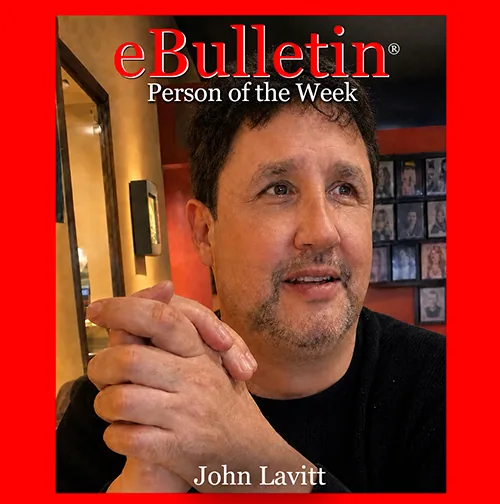
Brown graduate John Lavitt studied with poet Robert Lax on the Greek island of Patmos. He wrote 500-plus addiction-and-recovery articles for The Fix and now writes reviews for The Hollywood Times. A five-time Los Angeles Press Club honoree, he won first place in 2026 for Best Theatre/Performing Arts Critic, All Media.
Q: If you are in recovery, what was your drug(s) of choice and when is your sobriety date?
A. The two drugs that transcended choice and nearly destroyed my life were cocaine and heroin. I spent nearly half a million dollars smoking cocaine and crack while chasing the dragon of black tar heroin on tinfoil. My sobriety date is February 8, 2008. It marks the day I began reclaiming my freedom.
Q: Is there anything special in your sobriety toolkit that helps keep you sober?
A. There is a quiet voice in the back of my head that speaks whenever I consider using a drink or a drug to soothe lingering pain, console my soul after losing something or someone, or celebrate a success. When the fuck-its take over and I consider crossing that line, the voice whispers: “Well, now that would be a brilliant idea. Why don’t we take a bad situation and make it ten times worse? Why not screw up another milestone by shooting ourselves in the foot? Isn’t that just a wonderful notion?”
That voice keeps me from casually or impulsively subverting the gift of this life. I believe it is the voice of my Higher Power within me. The Gospel of Thomas teaches that the Kingdom of God is within us and reminds us without hesitation: “If you bring forth what is within you, what you bring forth will save you. If you do not bring forth what is within you, what you do not bring forth will destroy you.”
Q: Do you think addiction is an illness, disease, a choice, or a wicked twist of fate?
A. I believe alcoholism and addiction are diseases, based on the overwhelming medical evidence. However, there is no history of either disease in my family tree, and I do not believe I was born destined to become an addict. As Dr. Gabor Maté underscores, “The question is not why the addiction, but why the pain.”
Given the childhood trauma I experienced as a stutterer, a child with a disability growing up in a loving but difficult family, I am not surprised that I embraced the escape substances offered when I discovered them in high school. Marijuana became my first true addiction. In a strange and terrible way, drugs may initially have saved my life before they began destroying it.
Q: If you had an extra million dollars, which charity would you donate it to?
A. The two charities I support monthly are St. Jude Children’s Research Hospital and Médecins Sans Frontières (Doctors Without Borders). If I had an extra million dollars, I would split it between them to help children facing life-threatening illnesses and people confronting war, displacement, epidemics, and disaster.
Q: Who has been the biggest influence throughout your life?
A. While backpacking through Greece in the summer of 1986, after my sophomore year at Brown University, I met the American poet Robert Lax on the holy island of Patmos. Bob became my mentor, and for nearly fifteen years, I returned to the island again and again, living there for extended periods in 1989–90 and 1997–98.
Bob died in 2000 at the age of 84. How I miss his presence in my life. He looked as though he had just stepped down from among the sculpted saints of Chartres Cathedral. Indeed, he was a true holy man, like a cross between the Chinese Taoist sage Chuang-Tzu and Charlie Chaplin. Through humor and kindness, he taught me more than I can possibly express. I know that he remains by my side and within my soul.
Q: If you could give advice to your younger self, what would it be?
A. In my wallet, I carry a laminated photograph of my father and me on the beach at the Ocean Beach Club in Deal, New Jersey. Although we both appear to be smiling, I see so much tension and fear in that little boy’s face. I wish I could hold him and tell him that everything will be all right.
Yes, the journey will be difficult, with hard days and nights. But no matter what happens, you are a beautiful soul, worthy of love and capable of giving so much to the world. Believe in yourself, and the world will believe in you. And remember: You do not have to be perfect. You only have to be yourself. Who you are is enough.
Q: What major event or realization shaped who you are?
A. There is a profound difference between getting sober and learning how to live a sober life grounded in principles and integrity. When I entered the rooms, there was so much damage to navigate and so much wreckage in my past.
I thought of Walter Benjamin’s interpretation of Paul Klee’s Angelus Novus. Benjamin’s “angel of history” faces the accumulating ruins of the past while a storm caught in his wings propels him backward into the future. “The storm,” Benjamin writes, “is what we call progress.”
I felt like the angel of my own personal history. The realization that shaped who I am today was that recovery is about spiritual progress, not spiritual perfection. I cannot change the world or undo the past, but I can live with decency and kindness today. I can make progress by showing up, one day at a time, and being of service to my fellow souls on this long, strange trip we call life.
Q: What do you love most about living sober?
A. When I was in my cups and chasing my various dragons, I could not enter a room without feeling either more than or less than everyone else. I was affronted that no one stood up and applauded me, because don’t you know who the hell I think I am? Or I was convinced that everyone hated me, talked about me behind my back, and thought I was a piece of crap. Both extremes were distortions born of my disease of perception and my character defects. As my best friend loves to say, “Our character defects are the lies we tell ourselves about ourselves.”
Today, living sober, I no longer have to lug those distortions around in a burdensome backpack of evil shit. Instead, I have the freedom to be myself. Not the best little boy in the room. Not the worst little boy in the room. Just John. God, I love the freedom of living authentically and feeling comfortable in my own skin.
Q: Which part of your treatment and recovery do you feel was the most interesting or unexpected?
A. I did not expect the concept of the disease of perception to be so powerful when applied to alcoholism and addiction. Beyond using alcohol and drugs to escape reality, I do not always see things clearly. The trauma I experienced as a child continues to warp how I perceive myself, other people, and the world around me. Hence, I definitely need the tool belt of the Twelve Steps to survive in the world and navigate my life.
Through the tools of externalization, I gain freedom from the thoughts in my head when they fester, simmer, and pound. By talking with a trusted fellowship about what I am experiencing and feeling, I am able to free myself from the bonds of the disease of perception. By trusting the intentions of my closest advisors, including my sponsor, I have continued to evolve over the years. But the disease always remains, doing pushups in the nether regions of my mind, waiting for me to falter into egotism and self-obsession.
Q: What’s your concept of a Higher Power?
A. My concept of a Higher Power is closest to a Taoist view of a cosmic force or essence that is the beating heart of the universe. Like the Buddhist notion of Nirvana, it is well beyond our ability to understand. After all, on a universal timeline, we are primates with iPhones who just got out of the trees a moment ago. We have been conscious for such a minuscule blip in time. Hence, for me to say that God is absolutely this or God is absolutely that requires a level of arrogance I cannot embrace.
Instead, I prefer the understanding of the Godhead described by Ramakrishna, the 19th-century Hindu Vedanta mystic: All the world’s religions and spiritual practices are rivers leading to the same ocean, and we can learn something from each of their flows.
When it comes to connecting with a Higher Power, I explain to my sponsees in a 12-Step program that you have to be willing to take the first step through meditation and prayer. Your Higher Power, however you choose to define it, will not come to you if your back is turned and your arms are crossed. You need to take that first step by quieting your mind and embracing humility and respect. The voice of your Higher Power within you is clear yet soft. It does not have to bang drums or wave flags. It will not scream.
Q: What is your Astrological sign?
A. My astrological sign is Scorpio, and I had a fascinating experience years ago when an American astrologer on the Greek island of Patmos read my chart. Apparently, I am pure Scorpio, with a Scorpio moon, Leo Rising, and several planets in Scorpio. She said I was a scary person with tremendous powers and that I should maybe leave sooner rather than later. She was joking at the time, but there was a hint of worry in her voice.
In truth, I don’t know whether I believe in the whole Zodiac, but, like a true Scorpio, I definitely believe in the veracity of my own sign.
Q: What books are you reading now?
A. I have been blessed recently with the opportunity to become embedded in the popular and dynamic Longevity Movement in the United States. In Aspiring Magazine, a glossy East Coast quarterly, I have an ongoing column called “Longevity and the Lavinator.” The Lavinator was my nickname in Hollywood back in the day: He will not stop until he gets his movies made.
To learn more about the history of the movement and its evidence-based approach, I am reading and rereading Super Agers: An Evidence-Based Approach to Longevity by Dr. Eric Topol and Outlive: The Science & Art of Longevity by Dr. Peter Attia. Although I consider myself a pretty smart guy, I was never a science guy, and it takes me extra effort to absorb and incorporate the new ideas across the wide variety of fields they cover.
Q: If you were giving a dinner party for your 3 favorite authors, living or dead, who would they be? (You can choose a 4th if you think one might be too drunk or stoned to attend.)
A. I am going to pick four authors to sit at the table with a magical translation app that allows everyone to understand everyone else. I am also giving them a magic pill that brings them all up to date on world history and everything that has happened since their deaths. If we are entering the realm of the fantastic, then I feel fine expanding the boundaries.
First, Emily Dickinson, America’s greatest poet, because I want to hear her voice in the context of true freedom. Second, Leo Tolstoy, not at the end of his life, when he became something of a religious fanatic, but in the midst of his spiritual transformation in his mid-to-late fifties, when he still respected his literary masterpieces. Third, George Orwell, because I deeply admire how he always stood by his principles and how those principles became the driving force behind his greatest literary works. Fourth, Samuel Beckett, because I still have so many questions about Waiting for Godot.
Q: Which film have you watched the most?
A. If I were answering the question as asked, I would write about The Godfather I and II because I have seen them dozens of times, but that answer would be too obvious. Instead, I want to pick three obscure films, each of which I have watched multiple times and want to share with you.
First, Local Hero (1983) by Bill Forsyth is a delightful, understated Scottish comedy starring Burt Lancaster that captures the eccentricities of small-town life. Second, Before the Devil Knows You’re Dead (2007), directed by the legendary Sidney Lumet in his final feature, allows Philip Seymour Hoffman, Ethan Hawke, and Marisa Tomei to truly shine. Third, Under the Volcano (1984) by John Huston features Albert Finney delivering the most unforgiving portrayal of an alcoholic I have ever seen on film, and I say that as someone who loves Nicolas Cage in Leaving Las Vegas.
Q: What book would you most like to see turned into a movie or TV show that hasn’t already been adapted?
A. Given advances in digital tools and special effects, I would love to see Karel Čapek’s War with the Newts fully realized as a feature film. Published in 1936 by one of the great Czech writers of the 20th century, it is a relatively unknown dystopian masterpiece about human greed, exploitation, and our remarkable capacity to participate enthusiastically in our own destruction.
Q: Who are your heroes in real life?
A. Someone once said that heroes should never be spoken of in public for fear they will one day either coarsen into mere giants or shrivel into hollow men. Nevertheless, I am proud to say that one of my heroes is the Australian singer and musician Nick Cave, whose way of processing the trauma of losing his son in a public forum has helped so many others navigate their own tragedies. He is a hero because he transformed unimaginable grief into an ongoing act of generosity, giving back to others far beyond what was expected.
Q: What is your favorite city?
A. Although I love living in Los Angeles, my favorite city remains Paris. When I had the gift of an extended stay there in 1995, I wandered the streets like a flâneur, letting the city’s culture and history unfold around me.
Q: What is your favorite cuisine?
A. God, I love sushi and soft-shell crab. Japanese food makes me smile.
Q: What is the best concert/performance/play you’ve ever attended?
A. The best play I ever saw in person was Tony Kushner’s Angels in America: A Gay Fantasia on National Themes. Seeing the two parts back-to-back challenged me on many levels as a man, an intellectual, and an American. Millennium Approaches and Perestroika are beautiful, probing, exhausting, and deeply moving.
Q: What is the best piece of advice someone has given you?
A. My mentor Robert Lax told me that it might be a good idea if I stopped looking for answers to the questions that I thought had to be addressed and, instead, started looking for questions about those questions and questions about those questions and questions about those questions until I stumbled upon the question I was put here on this earth to ask.
Q: What do you value most in a friendship?
A. Loyalty, fidelity, and trust. I will always be there for my friends, and I want them to be there for me.
Q: What is your biggest fear?
A. In college, I wrote in a performance piece, “Most of all, more than anything else, I fear that you will never come. I fear that I will spend my entire life waiting for you and never find you. I fear that I will spend my entire life thinking of you, and that these dreams, so real that I can feel them like a sweltering summer wind, will remain only dreams, and that, in the depths of my bitterness, these desperate thoughts of you will always scratch like hungry cats at the windowpanes of my soul.”
Nearly four decades later, I still fear that you will never come.
Q: If you could wake up tomorrow having gained any one quality or ability, what would it be?
A. I wish I could travel back in time with what I know now and give it another shot. I imagine it would be an utter disaster, but I would like to try it all again, nevertheless.
Q. What do you love most about yourself?
A. I love my individuality and authenticity: I am truly myself, for better or for worse, and I have so many passions and loves in this world. There is so much I have done, and there is so much more that I long to do.
Q. What is your greatest extravagance?
A. My collecting is over-the-top. I have too much art, too many toys, and endless collectibles. Although I love what I collect, it is also a replacement addiction that distracts me from the actual work I am supposed to be doing. I avoid that work, yet when I finally do it, it brings me so much joy and happiness.